

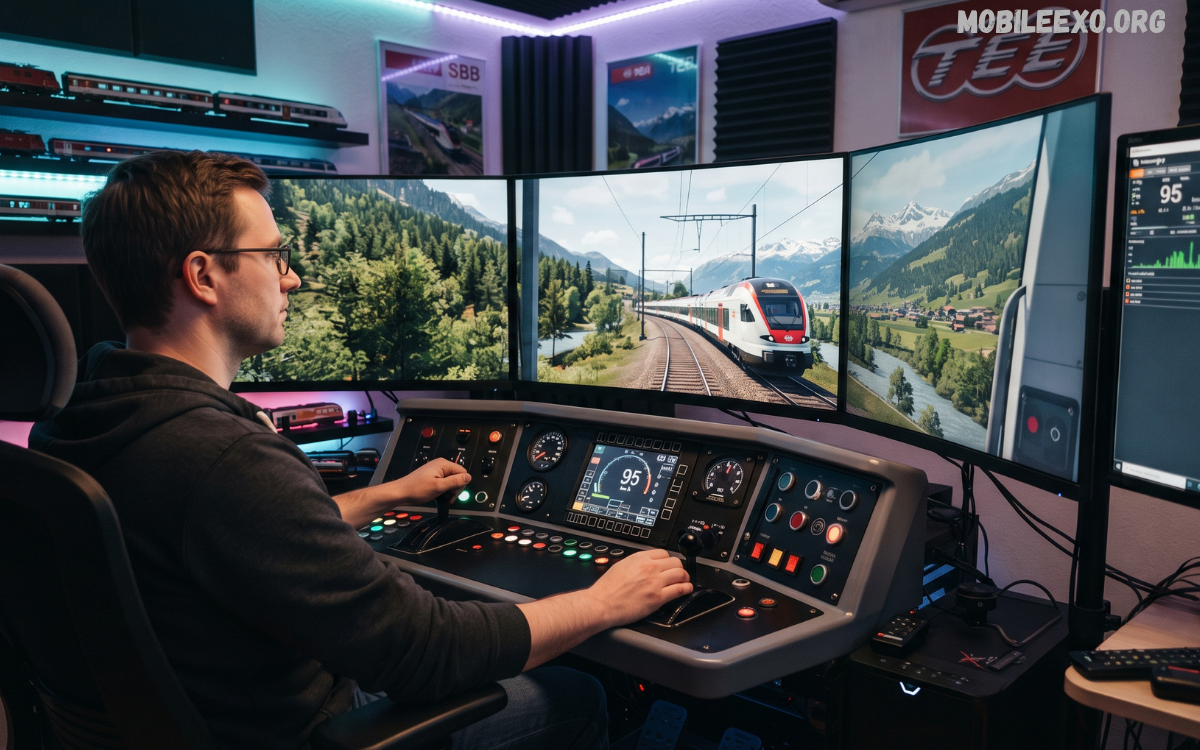
Train Simulator games have become a popular choice for players who enjoy realistic transportation experiences, strategic gameplay, and the fascinating world of railways. Unlike traditional action or racing games, a Train Simulator focuses on operating locomotives, managing railway routes, following signals, controlling speed, and completing journeys according to realistic schedules.
In 2026, Train Simulator games continue to evolve with improved graphics, realistic physics, detailed environments, and advanced gameplay systems. Modern simulators allow players to operate different types of trains across cities, countryside routes, mountain regions, and busy railway networks.
What Is a Train Simulator?
A Train Simulator is a video game or software application designed to recreate the experience of operating and managing trains. Players can control locomotives, accelerate and brake, follow railway signals, stop at stations, manage passengers or cargo, and travel along virtual railway routes.
The level of realism depends on the specific simulator. Some games provide simple controls and arcade-style gameplay, while advanced simulators attempt to reproduce real-world railway operations. These may include realistic train physics, changing weather, day-and-night cycles, signaling systems, speed restrictions, station schedules, and detailed locomotive controls.
Why Are Train Simulator Games Popular?
The popularity of Train Simulator games comes from their ability to offer a different type of gaming experience. Instead of focusing primarily on combat or fast-paced competition, these games allow players to enjoy a calmer and more methodical form of gameplay.
One major attraction is realism. Players can experience the process of driving a train while interacting with detailed controls and realistic railway environments. The feeling of traveling through cities, tunnels, bridges, forests, and mountains can make every journey feel unique.
Realistic Train Controls
Modern Train Simulator games often provide detailed controls that make driving more engaging. Depending on the game, players may control the throttle, brakes, horn, headlights, doors, pantograph, and other train systems.
Acceleration and braking require careful attention because trains are much heavier than ordinary vehicles. Stopping too late can cause the train to pass a station or violate a signal. Players therefore need to understand speed limits and anticipate upcoming stops.
Detailed Railway Routes
Routes are one of the most important elements of a quality Train Simulator. A well-designed route can make a journey significantly more immersive by combining realistic tracks with detailed surroundings.
Routes can include major cities, rural areas, industrial locations, forests, deserts, coastal regions, bridges, and mountainous landscapes. Some simulators recreate real railway lines, while others use fictional environments inspired by real transportation networks.
Different Types of Trains
A major advantage of Train Simulator games is the variety of locomotives available. Depending on the title, players may operate passenger trains, freight locomotives, high-speed trains, commuter trains, subway systems, or heritage locomotives.
Passenger trains generally focus on station schedules and comfortable journeys. Freight trains may introduce heavier loads and different acceleration characteristics. High-speed trains emphasize precise speed management and rapid travel between stations.
Train Simulator Gameplay Modes
Different gameplay modes help keep a Train Simulator interesting for a wide range of players. Career or mission modes usually give players specific objectives, such as completing a scheduled route, transporting passengers, or delivering cargo.
Free-play modes provide greater flexibility. Players can select a locomotive, choose a route, and enjoy a journey without strict objectives.
Graphics and Visual Realism
Graphics play a major role in creating an immersive Train Simulator experience. Modern simulation games can feature detailed locomotives, realistic railway stations, dynamic lighting, weather effects, and natural landscapes.
High-quality textures can make train interiors and exteriors look more authentic. Dynamic lighting can change the atmosphere during sunrise, daytime, sunset, and nighttime journeys.
Sound and Immersion
Sound design is another important part of a successful Train Simulator. Realistic locomotive sounds, wheel movement, brakes, horns, station announcements, and environmental effects can make the virtual railway feel alive.
The sound of a locomotive accelerating through a station or traveling along a long route can significantly improve immersion. Some simulators also include passenger and platform sounds to make stations feel more active.
Read Also: Driving Simulator: Experience Realistic Driving on Your Device
Train Simulator for Beginners
New players may initially find advanced Train Simulator games complicated because of the number of controls and railway rules. However, many modern games provide tutorials and beginner-friendly driving modes.
Starting with simplified controls is often a good way to learn the basics. Players can gradually become familiar with acceleration, braking, signals, speed limits, and station stops.
Train Simulator on Mobile Devices
Mobile gaming has made railway simulation more accessible. Train Simulator-style games on smartphones and tablets can provide convenient gameplay without requiring a dedicated gaming computer.
Mobile versions often simplify controls so that players can operate trains using touch-screen interfaces. Swiping, tapping, or virtual buttons can be used to control acceleration, braking, doors, and other functions.
Educational Value of Train Simulator Games
Although Train Simulator games are primarily designed for entertainment, they can also provide educational benefits. Players can develop an understanding of basic railway operations, signaling, scheduling, speed management, and transportation systems.
Simulation gameplay encourages observation and decision-making. Players need to monitor signals, anticipate stops, manage speed, and respond to changing conditions.
How to Choose the Best Train Simulator
Choosing the right Train Simulator depends on the type of experience you want. Players who prioritize realism should look for games with advanced physics, detailed controls, authentic routes, and realistic signaling systems.
Casual players may prefer a simulator with simple controls, attractive graphics, and straightforward missions. Mobile users should also check device compatibility and performance requirements.
Tips for a Better Train Simulator Experience
Learning the controls is one of the most effective ways to improve your performance. Instead of immediately selecting difficult routes, begin with shorter journeys and simple locomotives.
Pay close attention to signals and speed limits. Railway simulation often rewards careful driving rather than simply reaching the destination as quickly as possible.
Train Simulator vs. Traditional Racing Games
Train Simulator games differ significantly from traditional racing games. Racing games generally emphasize speed, competition, quick reactions, and overtaking opponents. Train simulators focus more on precision, planning, timing, and operational control.
A racing game may reward players for completing a track as quickly as possible. A Train Simulator may instead reward players for maintaining the correct speed, following signals, stopping accurately, and reaching stations according to schedule.
Future of Train Simulator Games
The future of Train Simulator gaming looks promising as technology continues to advance. Improvements in graphics processing, artificial intelligence, virtual reality, and physics simulation could make future railway experiences even more immersive.
Virtual reality could provide players with a stronger sense of being inside a locomotive cabin. Improved artificial intelligence could create more realistic traffic, passengers, railway operations, and environmental events.
Frequently Asked Questions
What is a Train Simulator?
A Train Simulator is a game or software experience that allows players to operate trains, travel across railway routes, follow signals, and complete different railway-related tasks.
Is Train Simulator suitable for beginners?
Yes. Many Train Simulator games include tutorials, simplified controls, and beginner-friendly scenarios that help new players learn the basic mechanics.
Can I play Train Simulator on mobile?
Yes. There are various train simulation games designed for Android and other mobile platforms, although their features and realism vary.
Are Train Simulator games realistic?
Some simulators are highly realistic and include detailed physics, signaling, weather, schedules, and train controls, while others provide a simpler arcade-style experience.
What can you do in a Train Simulator?
Players can operate passenger trains, freight locomotives, high-speed trains, and other railway vehicles while completing routes, missions, and scenarios.
Do Train Simulator games have different trains?
Yes. Many games offer multiple locomotive and train types, each with different performance characteristics and controls.
Can Train Simulator games be educational?
They can introduce players to basic concepts such as railway signaling, scheduling, speed management, train controls, and transportation systems.
What makes a Train Simulator enjoyable?
Realistic controls, detailed routes, diverse locomotives, immersive sound, attractive graphics, challenging scenarios, and exploration opportunities can make a Train Simulator enjoyable.
Can Train Simulator games be played offline?
Some games support offline gameplay, while others require an internet connection for certain features. Availability depends on the individual game.
What is the future of Train Simulator games?
Future simulators may benefit from improved graphics, artificial intelligence, virtual reality, physics systems, and cloud gaming technology, creating increasingly immersive railway experiences.
Conclusion
Train Simulator games offer a unique combination of realism, exploration, strategy, and entertainment. From operating powerful locomotives to traveling through detailed railway environments, these games provide an experience that is very different from conventional gaming genres.
In 2026, improvements in graphics, sound, physics, mobile technology, and simulation systems are helping Train Simulator games become more accessible and immersive. Beginners can enjoy simplified controls, while experienced players can explore advanced railway operations and realistic driving challenges.
