

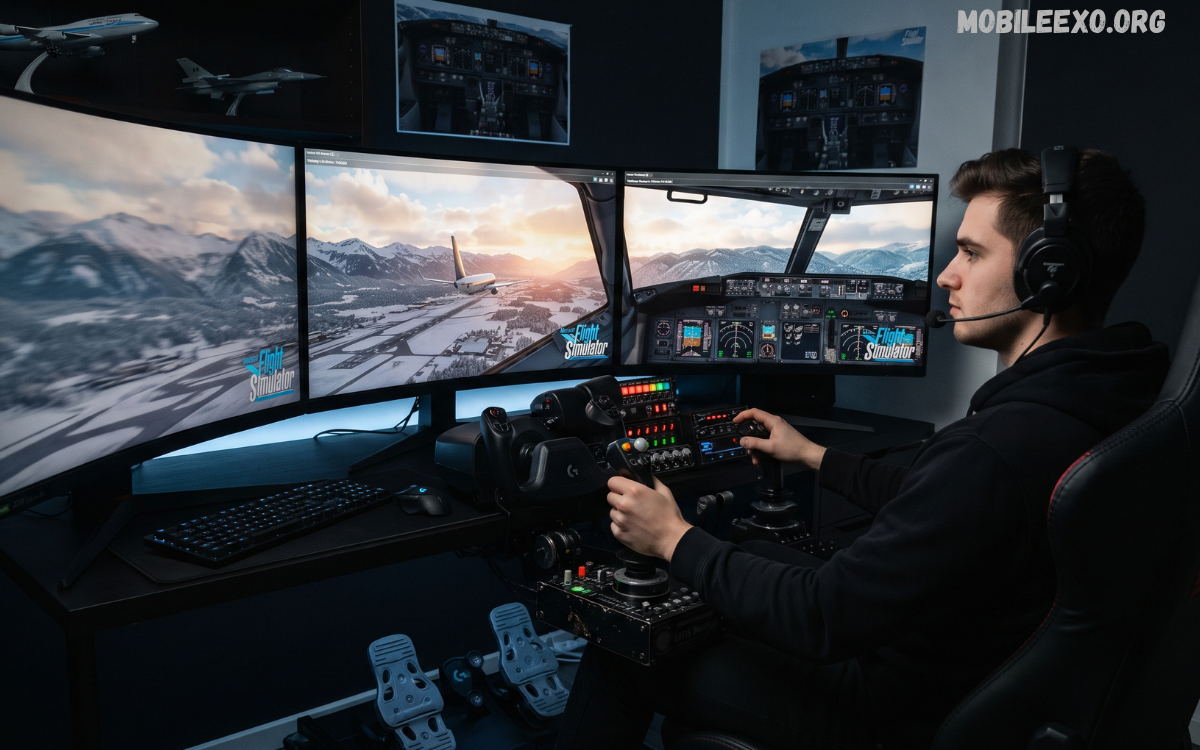
Flight simulator games have become a popular way for gaming enthusiasts to experience aviation from the comfort of their devices. These games combine realistic aircraft controls, detailed environments, challenging missions, and immersive flight mechanics to create an engaging virtual aviation experience.
Modern flight simulator games offer much more than simple aircraft controls, with advanced physics, dynamic weather, realistic airports, cockpit views, and different aircraft categories. Whether you are interested in commercial aviation, military aircraft, helicopters, or casual flying, there is a simulator designed to match your preferred experience.
What Are Flight Simulator Games?
Flight simulator games are digital applications designed to recreate the experience of operating an aircraft in a virtual environment. Players can control airplanes, helicopters, and other aircraft while managing altitude, speed, direction, navigation, landing, and takeoff procedures.
The level of realism varies significantly between games, with some focusing on accessibility and entertainment while others attempt to reproduce professional aviation procedures. Advanced titles can include realistic flight physics, cockpit instruments, navigation systems, weather conditions, air traffic, and detailed airport environments.
Why Are Flight Simulator Games Popular?
The growing popularity of flight simulator games comes from their ability to provide an aviation experience without requiring access to a real aircraft. Players can explore different locations, operate various aircraft, and practice basic aviation concepts through interactive gameplay.
Another major attraction is the combination of entertainment and learning. Flight simulators can introduce players to concepts such as altitude management, navigation, aircraft controls, airport procedures, and weather awareness while maintaining an engaging gaming environment.
Realistic Aircraft Controls
Aircraft controls are one of the most important features of high-quality flight simulator games. Realistic control systems allow players to manage the aircraft using virtual joysticks, touch controls, keyboards, gamepads, or dedicated flight equipment.
Advanced simulators can reproduce controls such as throttle, rudder, elevators, ailerons, landing gear, brakes, and autopilot systems. Learning these controls can make gameplay more challenging while providing a deeper understanding of how aircraft respond to different inputs.
Different Types of Flight Simulator Games
The flight simulation category includes several different gaming styles designed for different audiences. Some games focus on realistic commercial aviation, while others emphasize military combat, exploration, arcade-style flying, or casual mobile gameplay.
Commercial aviation simulators allow players to operate passenger aircraft and follow routes between airports. Military flight games can introduce fighter aircraft, tactical missions, and aerial challenges, while casual simulators usually prioritize accessible controls and fast-paced gameplay.
Commercial Flight Simulators
Commercial flight simulators are designed around the experience of operating passenger aircraft. Players can select aircraft, choose airports, plan routes, perform takeoffs, follow flight paths, and complete landing procedures.
Many commercial simulators provide detailed cockpits with numerous instruments and controls. These features create a realistic atmosphere for players who enjoy aviation procedures, airport operations, and long-distance virtual flights.
Military Flight Simulator Games
Military flight simulator games combine aviation mechanics with action-oriented gameplay. Players may operate fighter aircraft, complete missions, practice aerial maneuvers, or participate in fictional combat scenarios.
These games generally provide faster gameplay than traditional civilian simulators. They may include advanced aircraft, challenging missions, defensive systems, and different environments designed to test reaction speed and flying skills.
Mobile Flight Simulator Games
Smartphones and tablets have made flight simulation accessible to a much larger audience. Modern mobile flight simulator games can provide detailed aircraft models, realistic environments, customizable controls, and impressive graphics.
Touchscreen controls make these games convenient for casual players, while some titles also support external controllers. Mobile simulators are especially useful for players who want to enjoy aviation gameplay without using a desktop computer.
PC Flight Simulator Games
PC platforms remain popular among serious flight simulation enthusiasts because computers can support advanced graphics, detailed aircraft systems, and complex control configurations. Larger displays and powerful hardware can also create a more immersive cockpit experience.
PC simulators often support keyboards, mice, gamepads, joysticks, and specialized flight controls. Players can customize their setups according to their preferred level of realism and gameplay complexity.
Console Flight Simulators
Gaming consoles provide another convenient platform for flight simulation. Console flight simulator games typically balance realistic mechanics with accessible controls, making them suitable for players who want immersive aviation gameplay without building a dedicated PC setup.
Gamepads can provide precise control over aircraft while allowing players to enjoy detailed environments from a television screen. Some console titles also include exploration features, missions, challenges, and multiplayer experiences.
Realistic Weather Systems
Weather can significantly influence the experience offered by flight simulator games. Advanced titles may include rain, clouds, wind, storms, visibility changes, and other environmental conditions that affect aircraft handling.
Dynamic weather systems add another layer of challenge because players must adapt their flying techniques to changing conditions. These features can also make virtual flights feel more unpredictable and immersive.
Aircraft Variety
A strong aircraft selection can greatly improve the replay value of a flight simulator. Depending on the game, players may have access to passenger jets, private aircraft, cargo planes, helicopters, military aircraft, and smaller recreational airplanes.
Different aircraft usually have different performance characteristics and control requirements. Learning how each aircraft behaves can encourage players to experiment with new flight styles and missions.
Airports and Virtual Locations
Detailed airports and global locations are important elements of modern flight simulator games. Realistic runways, terminals, navigation points, landscapes, and city environments can make virtual flights feel more authentic.
Some games allow players to travel between numerous destinations around the world. Exploring different environments can turn a simple flight into a broader virtual travel experience.
Multiplayer Flight Experiences
Multiplayer functionality allows players to share virtual aviation experiences with other users. Depending on the game, players may fly together, participate in organized events, communicate during flights, or explore virtual destinations as a group.
Multiplayer features can make flight simulation more social and engaging. They also provide opportunities for players to learn from others and develop better flying techniques through shared experiences.
Flight Training and Learning
Flight simulator games can introduce players to basic aviation concepts in an interactive format. They can help users understand aircraft instruments, navigation principles, runway procedures, takeoff sequences, landing techniques, and basic flight management.
However, virtual simulation should not be considered a replacement for professional aviation training. Real-world flying requires qualified instructors, certified aircraft, formal education, and practical training in accordance with applicable aviation regulations.
Graphics and Visual Quality
Graphics play an important role in creating an immersive flight simulation experience. High-quality aircraft models, realistic cockpits, detailed landscapes, atmospheric effects, and accurately designed airports can make virtual flights significantly more engaging.
Modern hardware enables developers to create increasingly detailed environments. Improved lighting, terrain rendering, clouds, and cockpit animations can provide a stronger sense of realism during both daytime and nighttime flights.
Sound and Immersion
Sound design contributes significantly to the atmosphere of flight simulator games. Engine sounds, cockpit alerts, environmental audio, communication effects, and aircraft movement sounds can make gameplay feel more authentic.
Good audio design also helps players understand what is happening during a flight. Combined with detailed visuals and realistic controls, sound can create a convincing virtual cockpit environment.
Choosing the Right Flight Simulator
Choosing the right flight simulator depends on your preferred platform, experience level, and desired level of realism. Beginners may prefer games with simple controls and guided missions, while experienced players may want detailed aircraft systems and complex flight procedures.
Hardware compatibility should also be considered before selecting a simulator. Players using PCs can benefit from joysticks and other accessories, while mobile and console users may prefer games optimized for touchscreens or standard controllers.
Tips for Beginners
Beginners should start with an aircraft that has manageable controls and a simulator that provides tutorials or guided missions. Learning basic concepts gradually can make the experience more enjoyable and reduce frustration during difficult flights.
Practice should focus on fundamental skills such as maintaining altitude, controlling speed, following navigation routes, and performing stable landings. Once these skills become familiar, players can gradually move toward more advanced aircraft and challenging scenarios.
Read Also: Bus Simulator Games: Best Driving Experiences for Bus Enthusiasts
Future of Flight Simulator Games
The future of flight simulator games is expected to bring greater realism, improved artificial intelligence, better graphics, expanded multiplayer systems, and more detailed virtual environments. Advances in computing technology can allow developers to create increasingly sophisticated simulations.
Virtual reality and other immersive technologies may also play a larger role in aviation gaming. These technologies can provide more interactive cockpit experiences and make players feel increasingly connected to the virtual aircraft and environment.
Benefits of Playing Flight Simulator Games
Flight simulator games can provide entertainment while encouraging players to develop patience, attention to detail, coordination, and problem-solving skills. Managing multiple aircraft controls and responding to changing conditions can create a demanding but rewarding gaming experience.
These games can also encourage an interest in aviation and technology. Players who enjoy simulation may become interested in aircraft design, airport operations, navigation, meteorology, or the broader field of aviation.
Common Mistakes to Avoid
New players often attempt difficult flights before becoming familiar with basic controls. Starting with advanced aircraft or challenging weather conditions can make the learning process unnecessarily complicated.
Another common mistake is ignoring tutorials and control settings. Spending time understanding the aircraft, adjusting sensitivity, and practicing basic maneuvers can significantly improve the overall gameplay experience.
Frequently Asked Questions
What are flight simulator games?
Flight simulator games are digital games that recreate the experience of flying an aircraft. They can include realistic controls, aircraft systems, airports, weather conditions, navigation, and different flight scenarios.
Are flight simulator games suitable for beginners?
Yes, many flight simulator games include tutorials, simplified controls, training missions, and beginner-friendly aircraft. New players can start with basic flights before progressing to more advanced simulations.
Can I play flight simulator games on mobile devices?
Yes, numerous flight simulator games are available for Android and other mobile platforms. Mobile simulators commonly offer touchscreen controls, multiple aircraft, detailed environments, and customizable gameplay settings.
Are flight simulator games realistic?
The level of realism depends on the specific game. Advanced simulators can feature realistic physics, cockpit instruments, weather systems, navigation procedures, and aircraft behavior, while casual titles generally focus more on accessibility.
Can flight simulator games help me learn about aviation?
Flight simulators can introduce players to basic aviation concepts such as aircraft controls, navigation, altitude, speed, takeoff, and landing. However, they should not replace professional aviation instruction or real-world flight training.
What aircraft can I fly in flight simulator games?
Aircraft selection varies by game and can include passenger jets, private planes, cargo aircraft, helicopters, military aircraft, and smaller recreational airplanes. Some simulators provide extensive aircraft collections with different performance characteristics.
Do flight simulator games support multiplayer?
Many modern flight simulator games include multiplayer features. Depending on the title, players can fly together, explore virtual locations, participate in events, or communicate with other pilots.
Can I use a joystick with flight simulator games?
Many PC and console simulators support compatible joysticks, gamepads, and specialized flight controls. Using dedicated hardware can provide more precise controls and a more immersive cockpit experience.
What makes a good flight simulator game?
A quality flight simulator generally combines responsive controls, realistic aircraft behavior, detailed environments, effective sound design, varied aircraft, weather systems, and engaging gameplay. The ideal choice also depends on the player’s preferred platform and realism level.
What is the future of flight simulator games?
The future of flight simulator games is likely to include improved graphics, artificial intelligence, virtual reality, realistic weather, advanced aircraft systems, larger virtual environments, and enhanced multiplayer experiences. These developments can make aviation gaming increasingly immersive and interactive.
Conclusion
Flight simulator games provide an immersive way to explore aviation through realistic aircraft, detailed environments, challenging missions, and interactive controls. From mobile experiences to advanced PC simulators, the genre offers options for beginners, casual gamers, and dedicated aviation enthusiasts.
As technology continues to improve, flight simulation is becoming increasingly realistic and accessible. Whether you want to explore virtual destinations, learn basic aviation concepts, operate commercial aircraft, or simply enjoy the excitement of flying, flight simulator games offer a compelling gaming experience for aviation fans.

1 Comment
Pingback: Airplane Simulator Games: The Complete Guide to Realistic Flight Experiences - Mobileexo