

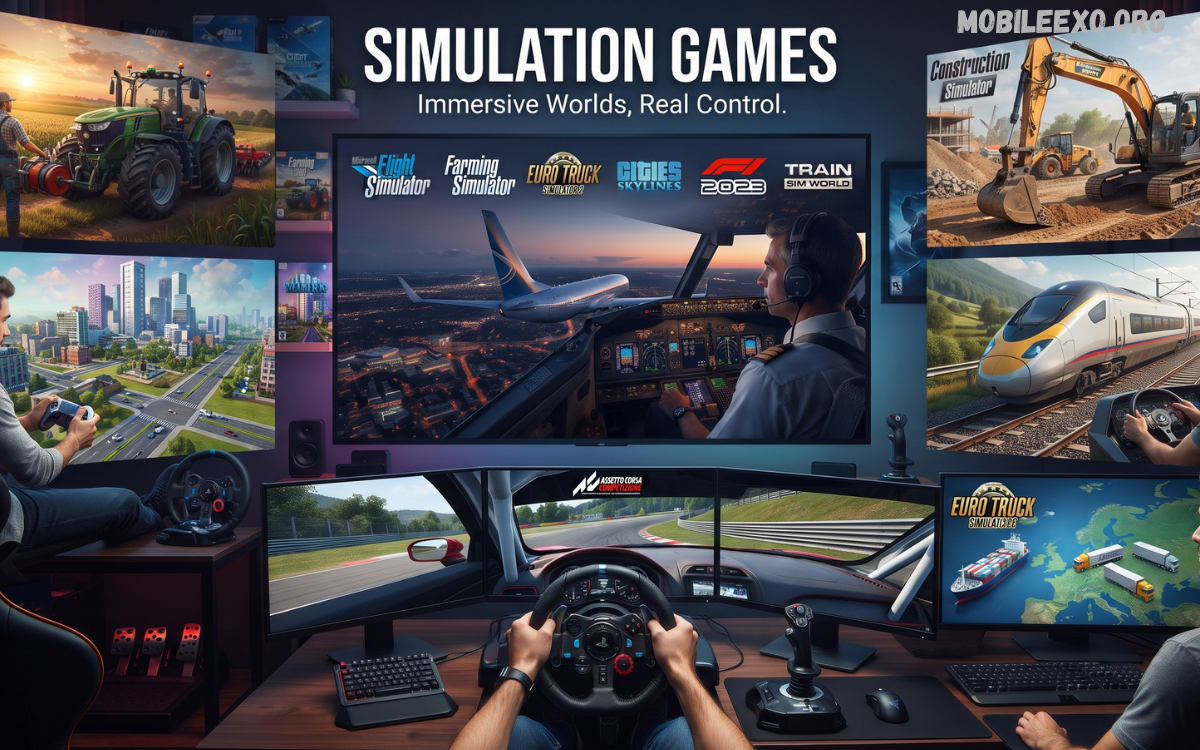
Modern gaming offers players opportunities to experience realistic activities through interactive digital environments. From managing cities and businesses to operating vehicles, farming virtual land, or building entire communities, simulation games provide experiences that combine entertainment, strategy, creativity, and decision-making.
The popularity of simulation games continues to grow because these titles allow players to explore situations that may be difficult, expensive, or impossible to experience in real life. Advanced graphics, realistic physics, artificial intelligence, detailed environments, and increasingly sophisticated gameplay systems have made modern simulation games more immersive than ever.
What Are Simulation Games?
Simulation games are interactive video games designed to recreate real-world activities, systems, professions, environments, or processes within a virtual setting. Instead of focusing exclusively on combat or traditional objectives, these games often emphasize management, planning, experimentation, creativity, and realistic decision-making.
Players can control vehicles, manage companies, operate farms, construct cities, run restaurants, design homes, or even simulate entire lifestyles depending on the game. Each title offers a different approach, but the central concept remains the same: creating a virtual experience that imitates aspects of real life.
Why Are Simulation Games So Popular?
One major reason behind the popularity of simulation games is their freedom and flexibility, allowing players to approach challenges according to their preferred strategies. Unlike many linear games, simulation titles often provide multiple possibilities, giving players greater control over decisions and outcomes.
Another important factor is realism, particularly in modern games that use advanced graphics engines and sophisticated physics systems. Detailed environments, realistic weather, responsive controls, intelligent characters, and dynamic economies can make players feel connected to the virtual world.
Simulation games also appeal to players who enjoy relaxing gameplay without constant pressure. Many farming, construction, life, and management simulations allow users to progress at their own pace while focusing on creativity, organization, and long-term goals.
Popular Types of Simulation Games
The simulation genre includes numerous subcategories, each offering a distinct gameplay experience and audience. Some of the most popular categories include life simulation, business simulation, city-building games, vehicle simulation, farming games, construction simulation, management games, and educational simulation titles.
Life simulation games allow players to control virtual characters and manage different aspects of their digital lives. These games can include activities such as creating homes, developing careers, building relationships, managing finances, and making everyday decisions.
Life Simulation Games
Life simulation games focus on recreating everyday experiences within a virtual environment. Players can create characters, customize homes, develop careers, explore communities, and make decisions that influence their virtual lives.
The appeal of life simulation games comes from their open-ended nature and customization options. Players can experiment with different lifestyles, create unique stories, and build virtual environments that reflect their creativity.
City-Building Simulation Games
City-building simulation games allow players to design, develop, and manage virtual cities. Players typically control infrastructure, transportation, housing, public services, economic development, and population growth.
Successful city management requires careful planning because every decision can influence the development of the virtual community. Poor transportation systems, insufficient resources, or ineffective budgeting can create challenges that require strategic solutions.
Farming Simulation Games
Farming simulation games provide players with virtual agricultural experiences involving crops, livestock, equipment, land management, and business development. These games combine relaxing gameplay with resource management and long-term planning.
Players usually begin with limited resources before gradually expanding their farms through profitable decisions. Seasonal changes, crop selection, machinery upgrades, livestock management, and market conditions can create increasingly complex challenges.
Vehicle Simulation Games
Vehicle simulation games recreate the experience of operating cars, trucks, buses, trains, aircraft, ships, and other forms of transportation. These games often prioritize realistic controls, physics, environments, and operating systems.
Driving and flight simulations are especially popular among players interested in realistic transportation experiences. Advanced simulation titles can include detailed dashboards, weather systems, traffic conditions, navigation features, and authentic vehicle behavior.
Business Simulation Games
Business simulation games allow players to manage companies, develop products, control budgets, hire employees, and compete within virtual markets. These games require strategic thinking because profitability often depends on balancing expenses, investments, customer satisfaction, and growth.
Business simulations can also introduce players to fundamental concepts related to management and economics. Although these games simplify real-world business operations, they can encourage players to think about resources, competition, planning, and long-term consequences.
Construction and Management Simulations
Construction simulation games focus on building structures, operating machinery, completing projects, and managing resources. Players may control construction companies, operate heavy equipment, plan projects, and complete contracts.
Management simulations expand this concept by allowing players to oversee entire organizations or facilities. Hotels, hospitals, restaurants, airports, theme parks, sports teams, and transportation networks can all become subjects of simulation-based gameplay.
Key Features of Modern Simulation Games
Modern simulation games include a wide range of features designed to improve realism and engagement. Dynamic environments, realistic physics, customization systems, progression mechanics, resource management, artificial intelligence, and detailed graphics are common elements.
Customization is particularly important because it allows players to personalize characters, vehicles, buildings, businesses, farms, and other virtual assets. Greater customization gives players more control over their experience and encourages creativity.
Realistic physics also play a significant role in simulation games, especially vehicle and construction titles. Accurate movement, environmental interactions, weather effects, vehicle handling, and object behavior can make gameplay feel more authentic.
Simulation Games and Strategy
Simulation games frequently overlap with strategy because players must make decisions that influence future outcomes. Managing limited resources, predicting market conditions, planning construction projects, and balancing expenses can require careful analysis.
Strategic thinking becomes increasingly important as simulation games become more complex. Players who plan ahead can often achieve better results than those who make decisions without considering long-term consequences.
Simulation Games and Creativity
Creativity is another major component of simulation gaming, particularly in construction, city-building, life, and design-focused titles. Players can create buildings, neighborhoods, businesses, characters, farms, transportation networks, and entire virtual communities.
Creative freedom allows simulation games to function as digital playgrounds where players can experiment without facing real-world consequences. This freedom encourages experimentation and provides endless opportunities to create unique experiences.
Educational Value of Simulation Games
Some simulation games can provide educational benefits by introducing players to concepts involving economics, management, engineering, transportation, agriculture, and environmental planning. Interactive systems can make complex concepts easier to understand because players can observe the consequences of their decisions.
Educational simulations are also used beyond entertainment, including professional training and academic environments. However, entertainment-focused simulation games should not be considered exact replacements for professional education because their systems are often simplified for gameplay.
Simulation Games on Mobile Devices
Mobile simulation games have expanded significantly as smartphones and tablets have become more powerful. Players can now access farming, city-building, business, vehicle, life, and management simulations without requiring a dedicated gaming computer or console.
Touchscreen controls also provide convenient interaction for many simulation genres. Mobile games frequently use shorter gameplay sessions, simplified interfaces, cloud synchronization, and progression systems designed for players who prefer gaming on the go.
Simulation Games on PC and Consoles
PC and console platforms continue to provide some of the most detailed simulation experiences available. Powerful hardware allows developers to create larger environments, advanced physics systems, complex artificial intelligence, and highly detailed graphics.
PC simulation games also benefit from extensive customization and community-created modifications in many titles. Mods can introduce new vehicles, maps, buildings, gameplay systems, visual improvements, and other content, extending the lifespan of simulation games.
Multiplayer Simulation Games
Multiplayer functionality has added another dimension to simulation gaming by allowing players to cooperate or compete within shared virtual environments. Friends can build cities, operate businesses, manage farms, drive vehicles, or complete projects together.
Cooperative gameplay can make simulation experiences more engaging because players can divide responsibilities and develop strategies as a team. Multiplayer environments can also create unexpected situations that make every session different.
Read Also: File Manager Apps: Complete Guide to Managing Files on Android
How to Choose the Right Simulation Game
Choosing the right simulation game depends on individual interests, preferred gameplay style, platform, complexity, and available time. Players who enjoy creativity may prefer city-building or life simulations, while those interested in realistic operations may prefer vehicle, farming, or construction titles.
It is also important to consider the game’s learning curve before starting. Some simulation games provide simple mechanics that are easy to understand, while advanced titles may include detailed systems requiring patience and experimentation.
Benefits of Playing Simulation Games
Simulation games can provide several entertainment benefits, including creativity, strategic thinking, planning, problem-solving, and experimentation. Players are often required to evaluate situations, manage resources, and adapt their strategies when unexpected challenges appear.
These games can also provide relaxing experiences, particularly when gameplay focuses on farming, construction, design, or exploration. The ability to progress gradually can make simulation games appealing to players who prefer slower-paced experiences.
The Future of Simulation Games
The future of simulation games is likely to involve more advanced artificial intelligence, realistic environments, improved physics, procedural generation, and immersive technologies. Developers are increasingly capable of creating virtual worlds that respond dynamically to player decisions.
Virtual reality and augmented reality may also expand simulation gaming by providing more immersive interactions. As technology continues to improve, simulation games could offer increasingly detailed environments that blur the boundary between traditional gaming and interactive digital experiences.
Tips for Enjoying Simulation Games
New players should begin by learning the basic mechanics rather than attempting to master every system immediately. Understanding resources, objectives, controls, and progression mechanics can make complex simulation games easier to enjoy.
Experimentation is equally important because simulation games are often designed around learning through experience. Trying different strategies, testing new approaches, and accepting occasional failures can help players understand how the virtual systems work.
Frequently Asked Questions
What are simulation games?
Simulation games are video games designed to recreate real-world activities, environments, professions, or systems in a virtual setting. They commonly focus on management, strategy, creativity, realistic interactions, and decision-making.
Why are simulation games popular?
Simulation games are popular because they provide realistic experiences while giving players freedom to explore different strategies and activities. Their variety, customization options, relaxing gameplay, and immersive environments attract players across different age groups.
What are the main types of simulation games?
Popular types include life simulation, farming simulation, city-building games, business simulation, vehicle simulation, construction games, management games, and educational simulations. Each category provides a different style of interactive gameplay.
Are simulation games suitable for beginners?
Many simulation games are suitable for beginners, especially titles with tutorials and simple gameplay systems. More advanced simulations may require additional time to understand their controls, mechanics, and management features.
Can simulation games improve strategic thinking?
Simulation games can encourage strategic thinking by requiring players to manage resources, plan activities, solve problems, and consider the consequences of their decisions. The level of strategic complexity depends on the individual game.
Can I play simulation games on mobile devices?
Yes, many simulation games are available for Android and iOS devices. Mobile simulation games cover categories such as farming, city building, business management, transportation, life simulation, and construction.
Are simulation games available on PC and consoles?
Yes, simulation games are widely available on PC and gaming consoles. These platforms can support highly detailed environments, advanced physics, larger maps, complex management systems, and extensive customization.
Do simulation games have multiplayer modes?
Many modern simulation games include multiplayer or cooperative features. These modes allow players to work together, manage virtual environments, complete projects, or participate in shared activities.
Are simulation games educational?
Some simulation games can introduce concepts related to economics, agriculture, transportation, management, engineering, and planning. However, entertainment simulations generally simplify real-world systems and should not replace formal education or professional training.
What makes a good simulation game?
A good simulation game typically combines engaging gameplay, responsive controls, meaningful progression, realistic or consistent systems, customization, and clear objectives. The best choice ultimately depends on the player’s interests and preferred level of complexity.
Conclusion
Simulation games have evolved into a major gaming category that combines realism, creativity, strategy, management, and entertainment. Their wide range of genres allows players to experience virtual farming, business management, city development, transportation, construction, daily life, and countless other activities.
As technology continues advancing, simulation games are expected to become more realistic, interactive, and accessible across mobile devices, PCs, consoles, and immersive platforms.
